 Brandt Snedeker Get A Trophy
 Brandt Snedeker Best Performance
 Brandt Snedeker Simple Smile
 Brandt Snedeker Say Hello To His Fans
 Brandt Snedeker Happiness Expression
 Brandt Snedeker Serious Expression
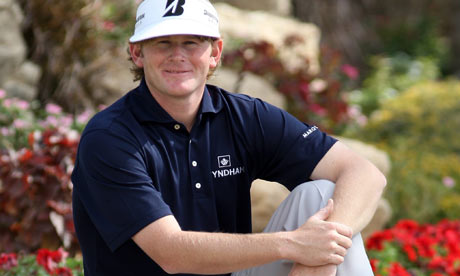 Brandt Snedeker Cool Pose
Brandt Snedeker Get A TrophyBrandt Snedeker Best PerformanceBrandt Snedeker Simple SmileBrandt Snedeker Say Hello To His FansBrandt Snedeker Happiness ExpressionBrandt Snedeker Serious ExpressionBrandt Snedeker Cool Pose
Brandt Snedeker Cool Pose
Brandt Snedeker Get A TrophyBrandt Snedeker Best PerformanceBrandt Snedeker Simple SmileBrandt Snedeker Say Hello To His FansBrandt Snedeker Happiness ExpressionBrandt Snedeker Serious ExpressionBrandt Snedeker Cool Pose
 The Houston Astros are a Major League Baseball team located in Houston, Texas. They are a member of the Central Division of the National League. Since 2000, they have played their home games at Minute Maid Park, formerly known as Enron Field. Their current majority owner is Drayton McLane, Jr. The Houston-based fruit juice manufacturer Minute Maid owned by The Coca-Cola Company, after whom the Astros' stadium is named, holds a minority stake in the team. The Astros were established as the Houston Colt .45s in 1962. They changed to their current name three years later, when they moved into the iconic Astrodome, the world's first domed sports stadium. The name references Houston's role as the center of the U.S. astronaut program. The Astros are the oldest MLB franchise to have never won the World Series while remaining in the same city over their history. After heart-breaking playoff losses in 1980, 1981, and 1986, and more playoff appearances in the late 1990s and early 2000s, the Astros finally appeared in their first and (to date) only World Series, in 2005 against the Chicago White Sox. Houston had been making efforts to bring a Major League franchise to the city before the expansion in 1962. There were four men chiefly responsible for bringing Major League Baseball to Houston: George Kirksey and Craig Cullinan, who had led a futile attempt to purchase the St. Louis Cardinals in 1952; R.E. "Bob" Smith, a prominent oilman and real estate magnate in Houston who was brought in for his financial resources; and Judge Roy Hofheinz, a former Mayor of Houston and Harris County Judge who was recruited for his salesmanship and political style. They formed the Houston Sports Association as their vehicle for attaining a big league franchise for the city of Houston.
 With Judge Roy Hofheinz now the sole owner of the franchise and his vision of an indoor venue complete, the Colt .45s moved into their new domed stadium in 1965. The judge called the new domed stadium the Astrodome. The name was in honor of Houston's importance to the country's space program and to match with the meaning of the name, the Colt .45s were renamed the Astros. The new park, coined as the "Eighth Wonder of the World" did little to help the play on the field. While several "indoor" firsts were accomplished, the team still finished ninth in the standings. The attendance was high not because of the team accomplishments, but because people came from miles around to see the Astrodome.In November 1971 the Astros and Cincinnati Reds made a blockbuster trade that was one of the most impactful in the history of the sport, and helped create The Big Red Machine of the 1970s, with the Reds getting the better end of the deal. Houston sent second baseman Joe Morgan, infielder Denis Menke, pitcher Jack Billingham, and outfielders Cesar Geronimo and prospect Ed Armbrister to Cincinnati for first baseman Lee May, second baseman Tommy Helms and infielder Jimmy Stewart. The trade left Astros fans and the baseball world scratching their heads as to why General Manager Spec Richardson would give up so much for so little. May and Helms were good talents but both had obvious weaknesses. The Reds on the other hand would shore up many problems.The Astros' opponent in their first ever World Series was the Chicago White Sox. Games 1 and 2 were held at U.S. Cellular Field in Chicago, while Games 3 and 4 were played at Minute Maid Park. Game 3 also marked the first Fall Classic game to be played in the state of Texas, and was the longest game by longevity in World Series history, lasting 5 hours and 41 minutes. Early conventional wisdom held that the White Sox were a slight favorite, but that Houston would be an even match. However, the Astros' situational hitting continued to plague them throughout the World Series. The White Sox swept the Astros in the best-of-seven series with a run differential of six.
 After years at the outdated Astrodome, the Astros moved into their new stadium in 2000. Originally called Enron Field, the stadium was one of the first to feature a functional retractable roof, considered a necessity in Houston. Additionally the ballpark featured more intimate surroundings than the cavernous Astrodome. It is believed by some that the departure of the NFL's Houston Oilers, after Houston refused to build them a new stadium, contributed to the construction of Enron Field. The ballpark features a train theme, since the ball park was built on the grounds of the old Union Station. The locomotive also pays homage to the history of Houston, where by 1860, 11 different railroad companies had lines running through the city. This is also represented in the city of Houston's official seal. A train whistle sounds, and a locomotive transverses a wall above the outfield after Astros hit a home run. The ballpark also contains quirks such as "Tal's Hill", which is a hill in deep center field on which a flagpole stands, all in fair territory. This was modeled after a similar feature that was located in Crosley Field, former home of the Cincinnati Reds. The terrace at Crosley Field was sloped at 15 degrees in left field, while Tal's Hill is sloped at 30 degrees in straightaway center. Over the years, many highlight reel catches have been made by center fielders running up the hill to make catches. Perhaps most significantly, with its short left field fence (only slightly longer to left field than Fenway Park), overall shorter dimensions, and exposure to the elements, including the humid Texas air, Enron Field played like a hitters' park. This was a dramatic difference from the Astrodome, which was considered to be an extreme pitchers' park. In a challenge to home run hitters, owner Drayton McLane's office windows, located in the old Union Station above left field, are made of glass and marked as 422' from home plate. With the change in location also came a change in attire. Gone were the blue and gold uniforms of the 1990s in favor a more "retro" look with pinstripes, a traditional baseball font, and the colors of brick red, sand and black. The "shooting star" logo was modified but still retained its definitive look.
 Junction Jack has been the mascot character for the Houston Astros since March 2000. He is a 7-foot (2.13 meter) tall rabbit dressed in the home pinstripe uniform. Other characters include Junction Julie and Junction Jesse. He walks around Minute Maid Park, greeting visitors, shaking hands, and posing for pictures. Outside of the stadium he will generally attend Astros-related promotional events, as well as charities. Junction Jack replaced Orbit when the team moved from the Astrodome to Minute Maid Park. The new stadium was originally called "The Ballpark at Union Station" because it was built on the site of the historic railway station in downtown Houston. In keeping with this new theme for the Astros, Orbit was replaced by the engineer. The character was designed by Logan Goodson and named by Duone Byars, both former Astros employees. A lime-green outer-space creature wearing an Astros jersey with antennae extending into baseballs. Orbit was the team's official mascot from the 1990 through the 1999 seasons. Orbit paid homage to Houston's association with NASA and nickname Space City.In April 1977 the Houston Astros introduced their very first mascot, Chester Charge. At that time there was only one other mascot in major league baseball, which was the San Diego Chicken. Chester Charge was a 45 pound costume of a cartoon Texas cavalry soldier on a horse. Chester appeared on the field at the beginning of each home game, during the seventh inning stretch and then ran around the bases at the conclusion of each win. At the blast of a bugle, the scoreboard would light up and the audience would yell, “Charge!” The first Chester Charge was played by Steve Ross who was then an 18-year-old Senior High School student. The creation of Chester Charge and the scoreboard graphics were created by Ed Henderson.
 Gabriel Omar Batistuta (born 1 February 1969), nicknamed Batigol is a former professional footballer. The prolific Argentine striker played most of his club football at Fiorentina in Italy, and he is the ninth top scorer of all time in the Italian Serie A league, with 184 goals in 318 matches. On the international level, he is Argentina's all-time leading goal scorer, with 56 goals in 78 national team matches, and he represented his country at three World Cups. In 2004, he was named in the FIFA 100 list of the "125 Greatest Living Footballers". When his club Fiorentina was relegated to Serie B in 1993, Batistuta stayed with the club and helped it return to the top-flight league a year later. A popular sporting figure in Florence, the Fiorentina fans erected a life-size bronze statue of him in 1996, in recognition of his performances for Fiorentina. He never won the Italian league with Fiorentina, but when he moved to Roma in 2000, he finally won the Serie A championship to crown his career in Italy. He played his last professional season in Qatar with Al-Arabi before he retired in 2005. At the age of 16, he met Irina Fernández, his future wife, at her quinceañera, a rite of passage on her 15th birthday. She is reported to have ignored him but five years later, on 28 December 1990, they were married at Saint Roque Church. The couple moved to Florence, Italy, in 1991, and a year later their first son, Thiago, was born. Thanks to good performances in the Italian championship and with the Argentine national team, Batistuta gained fame and respect. He filmed several commercials and was invited onto numerous TV shows, but in spite of this, Batistuta always remained a low-profile family man.Batistuta ended his career at Al-Arabi, retiring in March 2005, after a series of injuries that prevented him from playing. Soon afterwards he moved to Perth, Australia. In April 2006, the city's established A-league franchise, Perth Glory was put up for sale however Batistuta was not interested in the purchase seeing no real potential in the club.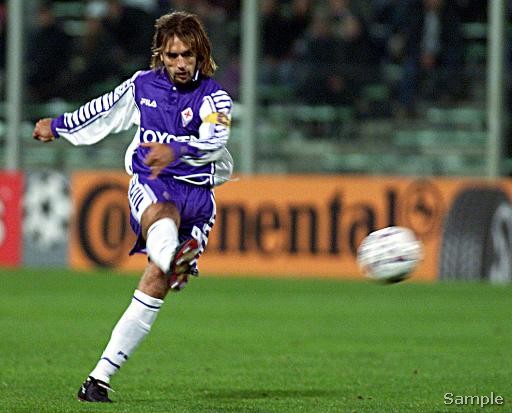
 As a child, Batistuta preferred other sports to football. Because of his height he played basketball, but after Argentina's victory in the 1978 FIFA World Cup, in which he was particularly impressed by the skills of Mario Kempes, he devoted himself to football. After playing with friends on the streets and in the small Grupo Alegria club, he joined the local Platense junior team. While with Platense he was selected for the Reconquista team that won the provincial championship by beating Newell's Old Boys from Rosario. His 2 goals drew the attention of the opposition team, and he signed for them in 1988.Batistuta signed professional forms with Newell's Old Boys, whose coach was Marcelo Bielsa, who would later become Batistuta's coach with the Argentine national team. Things did not come easily for Batistuta during his first year with the club. He was away from home, his family, and his girlfriend Irina, sleeping in a room at the stadium, and had a weight problem that slowed him down. At the end of that year he was loaned to a smaller team, Deportivo Italiano, of Buenos Aires, with whom he participated in the Carnevale Cup in Italy, ending as top scorer with 3 goals.While playing for Argentina in the 1991 Copa América, the vice-president of Fiorentina was impressed by Batistuta's skills and signed him for the Italian club. He had a fine start in Serie A, scoring 13 goals in his debut season. However, the following season (Serie A 1992-93) Fiorentina lost in the relegation battle and were demoted to the Serie B division, despite Batistuta's 16 season goals. The club returned to Serie A after one season in Serie B, with the contribution of 16 goals from Batistuta and the management of Claudio Ranieri. Batistuta stayed at Fiorentina for the 1999-00 season, tempted by the chance of winning both the Scudetto and the Champions League. After a promising start in both competitions, the team only reached seventh in the league and were eliminated in the second round group phase of the European tournament. The following season, he was transferred to Roma in a deal worth 70 billion Italian lire and signed a 3-year contract, which earned 14.8 billion Italian lire per year before tax.
 Batistuta failed to find form with Roma and was loaned out to Internazionale; however, he failed to make an impression scoring only 2 goals in 12 matches and departed for Qatari team Al-Arabi on a free transfer. In Qatar, he broke the record for most goals scored that was held by Qatari Legend Mansour Mouftah by scoring 24 goals. He scored more goals for the club than the number of games he played. He was awarded for being the top scorer in all Arab leagues in 2004 with a Golden Boot. In 1991, Batistuta was selected to play for Argentina in the Copa América held in Chile, where he finished the tournament as top scorer with six goals as Argentina romped to victory. In 1993, Batistuta played in his second Copa América, this time held in Ecuador, which Argentina again won. The 1994 World Cup, held in USA, was a disappointment: after a promising start Argentina were beaten by Romania in the last 16. The morale of the team was seriously affected by Diego Maradona's doping suspension. Despite the disappointing Argentine exit, Batistuta scored four goals in as many games, including a hat-trick in their opening game against Greece. During the qualification matches for the 1998 World Cup (with former River Plate manager Daniel Passarella) Batistuta was left out of the majority of the games after falling out with the coach over team rules. The two eventually put the dispute aside and Batistuta was recalled for the tournament. In the game against Jamaica, he recorded the second hat trick of his World Cup career, becoming the 4th player to achieve this (the others were Sándor Kocsis, Just Fontaine, and Gerd Müller) and the first to score a hat trick in 2 World Cups. Unfortunately, Argentina were knocked out of the World Cup the Netherlands courtesy of a last-minute Dennis Bergkamp winner after the two sides had held out for a 1-1 draw for almost the entire match. After a good series of performances by Argentina in the qualification matches for the 2002 World Cup, hopes were high that the South Americans - now managed by Marcelo Bielsa - could win the trophy, and Batistuta announced that he planned to quit the national team at the end of the tournament, which Argentina aimed to win. But Argentina's "group of death" saw the team fall at the first hurdle, only managing a victory against Nigeria. They later fell to England 1-0 and managed a mere 1-1 tie against Sweden. This meant that the team was knocked out in the opening round for the first time since 1962.
 Mark Henry Keys The Rival
 Mark Henry During The Match
 Mark Henry Wallpaper
 Mark Henry Smiling Mood
 Mark Henry Got A Medal
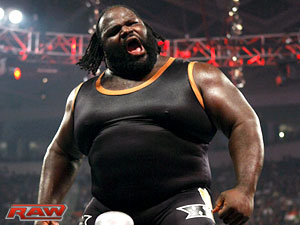 Mark Henry Strange Expression
 Mark Henry Show Up His Body
 Stephen Michael Ames (born April 28, 1964) is a professional golfer on the PGA Tour holding dual citizenship of Trinidad and Tobago and Canada.
 Stephen Ames and Trophy
 Ames's golfing talent developed early in life, assisted by support and discipline from his father, Michael. In his Hoerman Cup debut at the age of 16 in 1980, he smashed the course record at Sandy Lane, Barbados with a six-under-par total of 66.
 Stephen Ames Raise His Hands To His Fans
 Ames won a golf scholarship at Boca Raton, Florida in the United States and turned professional in 1987, but failed to win a PGA Tour card over the following few years, partly due to a neck injury. He won his first professional tournament in the United States (the Pensacola Open) in 1991 on the Ben Hogan Tour.
 Stephen Ames Performance
 Ames won for the fourth time on the PGA Tour in 2009, again at the Children's Miracle Network Classic, shooting a final round -8 64. He won in a three-way playoff over George McNeill and Justin Leonard.
 Miguel Odalis Tejada (born on May 25, 1974, in Baní, Dominican Republic) is a Major League Baseball infielder for the San Francisco Giants. He began his first six seasons of his career with the Oakland Athletics, where he began his streak of 1,152 consecutive games, that ended with the Baltimore Orioles on June 22, 2007. In 2002, he was awarded the AL MVP award, and he was the MVP of the 2005 All-Star Game. His nickname is "La Gua Gua" which means "the bus" in certain Spanish dialects, as Tejada is known to drive in runs. On February 11, 2009, he pleaded guilty to one count of perjury for lying to Congress in his testimony on whether or not Rafael Palmeiro lied about his steroid use. Tejada developed quickly into a top-notch prospect, showing early signs of power. He reached the Majors towards the end of the 1997 season, joining a struggling Oakland Athletics club. Though he only hit .202 in 26 games that year, the A's saw potential in the 23-year-old Tejada. This was bolstered by his performance with the Edmonton Trappers (AAA) in the Pacific Coast League during the season, and returning to the minors to lead the Trappers to a PCL championship that year. He was rewarded with the starting shortstop job beginning in 1998.
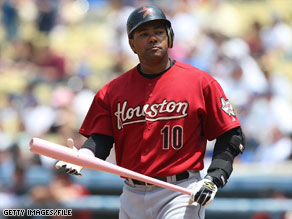 Tejada's breakout year came in 2002. With the departure of Jason Giambi to the New York Yankees during the offseason, and a leg injury to slugger Jermaine Dye, the A's lost two of their key offensive players. Tejada hit .308 with 34 homers and led the A's to their second Western Division title in three years. Their campaign included an American League record 20 game winning-streak. Tejada contributed one-out, game-winning hits in the 18th and 19th games of that run: a three-run homer off Minnesota Twins closer Eddie Guardado for a 7-5 victory and a bases-loaded single against Kansas City Royals reliever Jason Grimsley to break a 6-6 tie. Tejada also showed modest speed on the basepaths with 18 steals over a two-year stretch. His performance was rewarded with the 2002 American League MVP award. For the third straight year, though, the A's fell in the fifth game of the ALDS, this time to the Minnesota Twins.By the end of the 2003 season, Tejada had established himself as one of baseball's premier shortstops. The A's elected not to re-sign the free agent, citing budget concerns and a young Bobby Crosby coming through the system, so Tejada signed a six-year, $72 million deal with the Baltimore Orioles during the offseason.Tejada scored his 1,000th career run on July 7, 2008, at PNC Park. In the 2008 All-Star Game Tejada singled leading off the top of the eighth stole second with one out and advanced to third on a throwing error and scored on Padres' first baseman Adrian Gonzalez"s sacrifice fly.Tejada signed a one year contract with the San Francisco Giants.
 Miguel Tejada Best Performance
 Miguel Tejada Serious Pose
 Miguel Tejada Happiness Expression
 Miguel Tejada Poster
 Miguel Tejada Catch The ball Perfectly
 Liverpool Football Club is an English professional football club from Liverpool, England, and plays in the Premier League. Liverpool has played at Anfield since the club's foundation in 1892 and was admitted to the Football League a year later. England's most successful club of the 20th century and one of the most successful clubs in the history of English football, Liverpool has won a joint-record 18 league titles, seven FA Cups and a record seven League Cups. Liverpool is also the most successful English club in European competition having won five European Cups, the last in 2005, and three UEFA Cups. The club currently rank third in Europe and sixth in the world with the most international titles won. The club's supporters have been involved in two major tragedies. The first was the Heysel Stadium disaster in 1985, where charging Liverpool fans caused a wall to collapse, resulting in the death of 39 Juventus supporters. In the 1989 Hillsborough Disaster, 96 Liverpool supporters lost their lives in a crush against perimeter fencing. Liverpool has long-standing rivalries with neighbours Everton and with Manchester United. The team's home colours have been entirely red since 1964 when manager Bill Shankly changed them from a red shirt and white shorts. The club's anthem is "You'll Never Walk Alone". Liverpool F.C. was founded following a dispute between the Everton F.C. Committee and John Houlding, club president and owner of the land at Anfield. After eight years at the stadium, Everton relocated to Goodison Park in 1892 and Houlding founded Liverpool F.C. to play at Anfield. Originally named Everton F.C. and Athletic Grounds Ltd (Everton Athletic for short), the club became Liverpool F.C. in June 1892 after The Football Association refused to recognise the club as Everton. In its debut season, the team won the Lancashire League, before joining the Football League Second Division at the start of the 1893–94 season. After finishing in first place, the club was promoted to First Division, which it won in 1901, and again in 1906. Liverpool won back-to-back league championships in 1922 and 1923, but did not win another trophy until the 1946–47 season when the club won the First Division for a fifth time. After losing 1–0 to Burnley F.C. in the club's first FA Cup final in 1914, Liverpool was defeated in the final for a second time in 1950 by Arsenal. The club was relegated to the Second Division in the 1953–54 season.
 The famous liver bird first took its perch on the left-hand side of the chest in the 1950 FA Cup Final defeat to Arsenal and is a symbol that has continued to signify the prestige involved with playing for Liverpool FC. The crest was revived for the 1955-56 season, and was appearing out of a white oval with L.F.C. embroided below the liver bird. This version was used until 1969. In 1968 the decision was taken to introduce a more modern version of the club crest. The liver bird was now embroidered directly onto the team's shirts with the removal of the white oval and shields. For seven years this was used in white but from 1976 the emblem was changed to gold and reverting back to white when the club dropped Umbro as their kit supplier and signed a contract with Adidas in 1985. In 1992 the club adopted a new crest to celebrate their centenary. The familiar liver bird remained as the centrepiece but now appeared against a red and white shield. Above the shield is a representation of the Shankly Gates with the title of club's famous anthem, "You'll Never Walk Alone". The twin flames at either side are symbolic of the Hillsborough memorial outside Anfield, where an eternal flame burns in memory of those who died in the disaster. Since 1992 the crest has only undergone some minor changes until it was updated in 1999. The present crest has been relatively unchanged since then when it first appeared on the shirt in just two colours but after 2002 it appeared in full colour. Liverpool's first competitive game was an 8–0 victory in the Lancashire League against Higher Walton. Ian Callaghan holds Liverpool's overall appearance record—he played 857 matches over the course of 19 seasons from 1958 to 1978- and the record for League appearances with 640. Of the current squad, Jamie Carragher has the most appearances; he played his 600th game for the club early in 2010. Liverpool's all-time leading scorer in all competitions is Ian Rush, who scored 346 goals in two spells at the club from 1980 to 1987 and 1988 to 1996, and also holds the record for the most goals in a season with 47 in 1983–84. However Rush could not surpass Roger Hunt's record number of league goals of 245. In the 1961–62 season, Hunt scored 41 goals, which is the club record for league goals in a single season. Gordon Hodgson, the club's third highest scorer with 240 goals, holds the club record of 17 hat tricks. The most goals scored by a player in a single match is five; John Miller, Andy McGuigan, John Evans, Ian Rush and Robbie Fowler have achieved this feat. Fowler also holds the club and Premier League record for the fastest hat trick: he scored three goals in four minutes, 32 seconds against Arsenal in the 1994–95 season. Steven Gerrard is Liverpool's all-time leading goalscorer in European competition with 34 goals. Liverpool's record home attendance is 61,905, for a FA Cup match against Wolves on 2 February 1952. The record modern (all-seated) attendance is 44,983 for a match against Tottenham Hotspur on 14 January 2006. The club's record lowest attendance is 1,000 for a match against Loughborough during the 1895–96 season. Liverpool's biggest victory is 11–0 against Strømsgodset IF in 1974. Liverpool's 10–1 defeat of Rotherham Town in 1896 was the club's largest league win. This margin of victory was matched when Crystal Palace was defeated 9–0 at Anfield in 1989. Liverpool's heaviest defeat, 1–9, came against Birmingham City in 1954. Liverpool's 8–0 win against Beşiktaş J.K. in the Champions League was the largest victory in the competition's history at the time (November 2007).
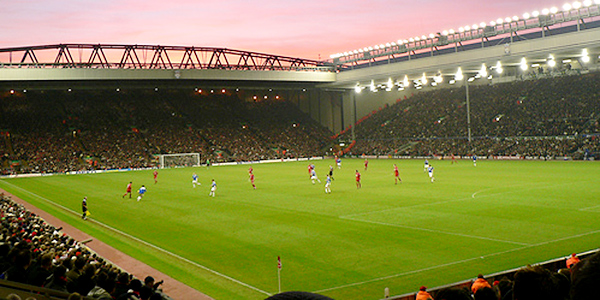 Anfield was built in 1884 on land adjacent to Stanley Park, the ground was originally used by Everton before they moved to Goodison Park after a dispute over a rent with the owner of the ground John Houlding. Left with an empty ground Houlding founded Liverpool in 1892 and the club have played at Anfield since then. The capacity of the stadium at the time was 20,000, although only 100 spectators attended Liverpool's first match at Anfield. In 1906, the banked stand at one end of the ground was formally renamed the Spion Kop after a hill in Natal. The hill was the site of the Battle of Spion Kop in the Second Boer War, where over 300 men of the Lancashire Regiment died, many of whom were from Liverpool. At its peak, the stand could hold 28,000 spectators, and was one of the largest single tier stands in the world. Many stadia in England had stands named after the Spion Kop, but Anfield's was the largest Kop in the country at the time; it was able to hold more supporters than some entire football grounds. Anfield could hold over 60,000 supporters at its peak, and had a capacity of 55,000 until the 1990s. The Taylor Report and Premier League regulations obliged Liverpool to convert Anfield to an all-seater stadium in time for the 1993–94 season, thus reducing the capacity to 45,276. The findings of the Taylor Report precipitated the redevelopment of the Kemlyn Road Stand. The stand was rebuilt in 1992, coinciding with the centenary of the club and is now known as the Centenary Stand. An extra tier was added to the Anfield Road end in 1998, which increased the capacity of the ground further, though the stand encountered problems upon opening. A series of support poles and stanchions were inserted to give extra stability to the top tier of the stand after movement of the tier was reported at the start of the 1999–2000 season. Due to the restrictions of expanding the capacity at Anfield, Liverpool announced plans to move a new stadium at Stanley Park in May 2002. Planning permission was granted in July 2004, and in September 2006, Liverpool City Council agreed to grant Liverpool a 999-year lease of the land on the proposed site. Following the takeover of the club in February 2007 by George Gillett and Tom Hicks, the proposed stadium was redesigned. In November 2007, the new design was approved by the Council, and preparation of the site started in June 2008, with HKS, Inc. contracted to build the stadium. Construction of the stadium was halted in May 2008, as Gillett and Hicks had trouble financing the £300 million needed for the development. New England Sports Ventures, who purchased the club on 15 October 2010, are evaluating the possibility of drastically refurbishing Anfield against building a new stadium.
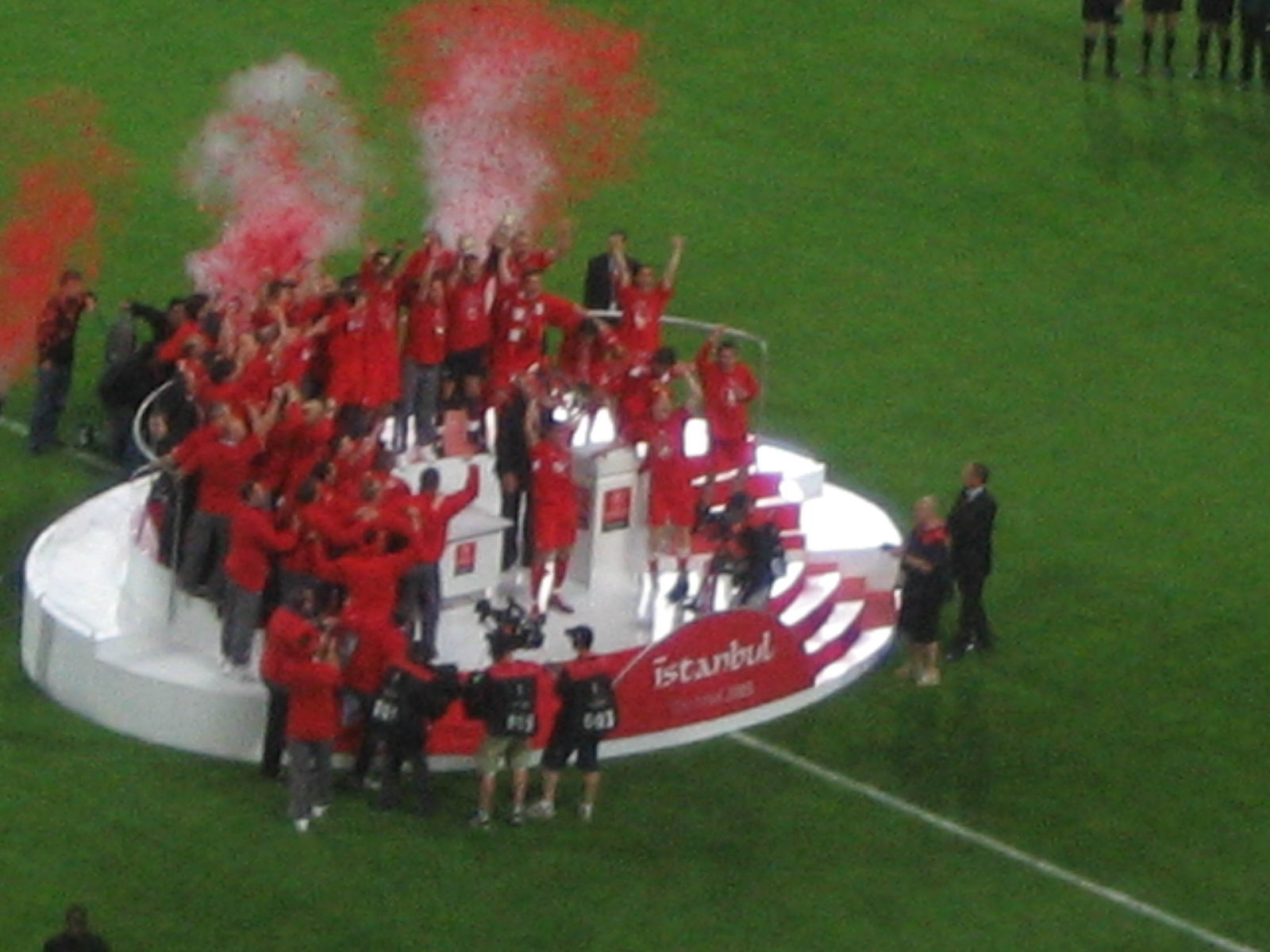 During the 2009–10 season, Liverpool had the fourth-highest average League attendance for an English club: 44,392, which is 94.4% of available capacity. Liverpool fans often refer to themselves as "Kopites", which is a reference to the fans who once stood, and now sit, on the Kop at Anfield. In 2008, a group of fans decided to form a splinter club, A.F.C. Liverpool, the club was set up to provide a match-going experience for fans who had been priced out of watching Premier League football. The song "You'll Never Walk Alone", originally from the Rodgers and Hammerstein musical Carousel and later recorded by Liverpool musicians Gerry & The Pacemakers, is the club's anthem, and has been sung by the Anfield crowd since the early 1960s. It has since gained popularity among fans of other clubs around the world. The song's title adorns the top of the Shankly Gates, which were unveiled on 2 August 1982 in memory of the former manager Bill Shankly. The "You'll Never Walk Alone" portion of the Shankly Gates is also reproduced on the club's crest. The club's supporters have been involved in two stadium disasters. The first was the 1985 Heysel Stadium disaster, in which 39 Juventus fans were killed. They were penned into a corner by Liverpool fans who had charged in their direction; the sheer number of fans cornered caused a wall to collapse. UEFA laid the blame for the incident solely on the fans of Liverpool, and banned all English clubs from European competition for five years. 27 fans were arrested on suspicion of manslaughter, they were extradited to Belgium to face trial in 1987. In 1989, after a 5-month trial in Belgium, fourteen Liverpool fans were given three year sentences for involuntary manslaughter, although half of the terms were suspended. The second was during an FA Cup semi-final between Liverpool and Nottingham Forest at Hillsborough Stadium, Sheffield on 15 April 1989. 96 Liverpool fans died due to overcrowding in the Leppings Lane End, in what became known as the Hillsborough disaster. The Sun newspaper published an article entitled "The Truth", in which it claimed that Liverpool fans had robbed and urinated on the dead and had attacked the police. Subsequent investigations proved the allegations to be false, and this led to a city-wide boycott of the newspaper. Many organisations were set up as a result of the disaster, such as the Hillsborough Justice Campaign, which represents bereaved families, survivors and supporters in their efforts to secure justice. Liverpool's longest-established rivalry is with fellow Merseyside team Everton, against whom the club contest the Merseyside derby. This stems from Liverpool's formation and the dispute with Everton officials and the then owners of Anfield. Religious differences have been cited as a cause of division, although both teams stem from a Methodist origin, which undermines the notion of a Catholic–Protestant split. The Merseyside derby is usually a sell-out fixture. It is one of the few local derbies that does not enforce fan segregation, as a result it was known as the "friendly derby". Since the mid 1980s, the rivalry has intensified on and off the field, and since the inception of the Premier League in 1992, the Merseyside derby has had more players sent off than any other Premier League game, thus has been referred to as "The most ill-disciplined and explosive fixture in the Premier League". Liverpool has a rivalry with Manchester United. The rivalry is viewed as a manifestation of the cities' competition during industrial times, when they competed for supremacy of the north-west; Liverpool was considered the world's pre-eminent port, while Manchester was famous for its textile industry. The rivalry between the clubs intensified from the 1960s onwards. In 1968, Manchester United became the first English team to win the European Cup, their achievement would soon be eclipsed by Liverpool who won four European Cups during the 1970s and 80s. Then in the 1990s Manchester United started to dominate English football making the rivalry all the more intense. The rivalry is so intense that the last player to be transferred between the two clubs was Phil Chisnall in 1964, when he moved to Liverpool from Manchester United.
